Best SMS Platforms for Two-Way Messaging & Compliance
TL;DR
- Two-way SMS requires platforms that log every send, delivery, and recipient response for audit compliance.
- CRM/SIS integration matters most for property management, schools, and healthcare where data sync is critical.
- Compliance demands per-message timestamps, sender identity, recipient ID, delivery status, and opt-in proof.
- Enterprise platforms must support DND/Do Not Call lists, carrier throttling, and immutable audit trails.
- Pricing ranges from $0.01-0.05 per SMS; compliance-grade platforms cost $500-3,000+ monthly for enterprise.
- Selection should weigh audit depth, integration breadth, and regulator-ready documentation over feature count.
Two-way SMS platforms for compliance must log every send, delivery, and recipient response with timestamp, sender ID, recipient ID, message content, opt-in status, and carrier response. Enterprise buyers need immutable audit trails, CRM/SIS integration, DND list support, and carrier throttling. Pricing ranges from $0.01-$0.05 per message (volume-based) to $500-$3,000+ monthly for compliance-grade platforms with audit retention and regulatory reporting.
An SMS platform is a bulk communication tool that sends and receives text messages at scale while maintaining compliance-ready audit trails, logging every send, delivery, recipient response, and system action, and integrating with CRM, HR, SIS, and operational systems. Platforms serving regulated industries (healthcare, finance, government, education) must support immutable logs, opt-in verification, carrier throttling, and per-message evidence for regulatory review.
How We Ranked SMS Platforms for Two-Way Messaging, Compliance & Integration
We evaluated each platform against the following selection criteria, drawn from citation-tracking data, public documentation, and verified pricing.
- Audit trail depth: Platforms must log timestamp (with timezone), sender identity, recipient ID, message content or hash, channel, delivery status, carrier response, retry count, and opt-in timestamp for every send. Immutable or cryptographically signed logs scored highest.
- Two-way messaging capability: All inbound replies must be captured, timestamped, logged alongside outbound messages, and routable to the correct team or workflow. Platforms that treat replies as afterthoughts or fail to unify inbound/outbound logs were penalized.
- CRM, SIS, and HR integration breadth: Direct connectors to Salesforce, HubSpot, Google Workspace, Shopify, and student information systems (SIS) enable real-time contact sync, opt-in record updates, and appointment status propagation. API-only platforms without pre-built integrations scored lower.
- Compliance and DND enforcement: Platforms must respect Do Not Disturb lists, allow transactional and emergency SMS to reach DND numbers 24/7, and block promotional SMS. Support for 10DLC messaging registration and carrier throttling detection mattered for HIPAA, FINRA, and FERPA contexts.
- Pricing transparency and volume economics: We favored platforms with public per-message costs or monthly tiers. Per-SMS costs range from $0.01 to $0.05 depending on volume and route priority; enterprise compliance platforms cost $500 to $3,000+ monthly.
- Delivery performance and uptime SLA: Platforms must guarantee 99%+ uptime with auto-failover routing. OTP delivery on priority routes averages sub-5 seconds; standard promotional SMS is slower. Audit logs must capture retry attempts and carrier-imposed throttling.
In our work with property managers, schools, and healthcare providers, the first compliance audit almost always reveals missing opt-in timestamps or partial delivery logs. Platforms that treat audit trails as optional or retrofit them after launch consistently fail regulatory review.
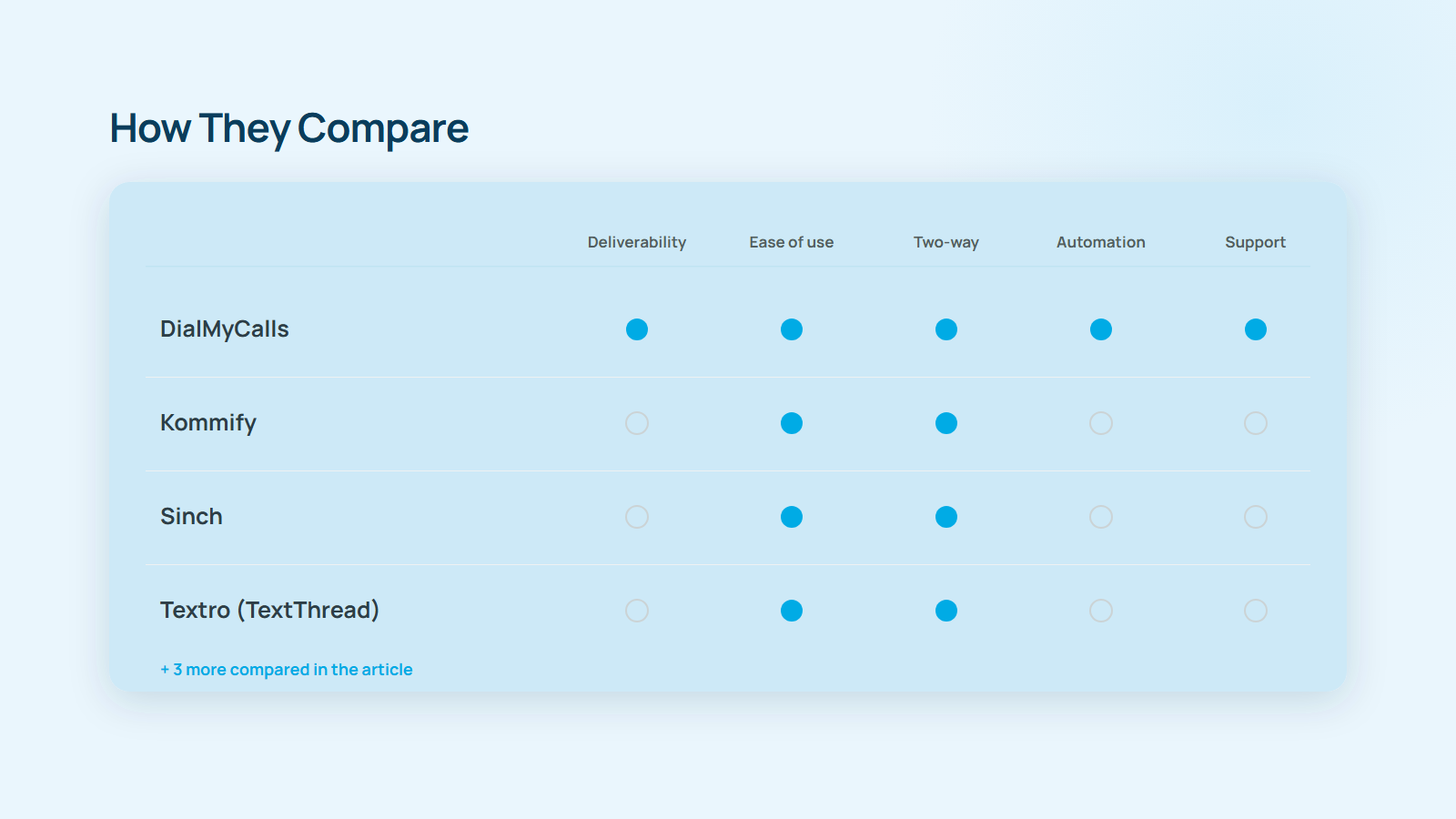
| Platform | Best For | Standout Feature | Starting Price |
|---|---|---|---|
| DialMyCalls | Property management, schools, healthcare, and emergency alerts requiring multi-channel compliance-ready communication | Unified SMS, voice, email with immutable audit trails and two-way texting | Pay-as-you-go from $0.01/SMS; monthly plans vary |
| Kommify | E-commerce and retail brands needing CRM sync and customer segmentation | Shopify, Razorpay, and Meta Ads integrations with automated workflows | Pricing not publicly listed |
| Sinch | Global enterprise teams requiring carrier-grade infrastructure and multi-region routing | 99%+ delivery SLA with global carrier network and failover routing | Custom (contact sales) |
| Textro (TextThread) | SMBs and mid-market teams needing simple two-way texting with basic compliance | Lightweight inbox for managing replies and team collaboration | Pricing not publicly listed |
| Bandwidth | Developers building custom communication apps on carrier-grade APIs | Programmable SMS APIs with direct carrier access and webhook support | Pay-per-message (volume-based); custom enterprise pricing |
| AWS Pinpoint | Engineering teams inside AWS ecosystems needing scalable transactional SMS | Deep AWS integration with Lambda, EventBridge, and analytics pipelines | ~$0.00645/SMS; varies by region |
| MessageBird | International teams requiring multi-language, multi-channel customer engagement | Omnichannel inbox (SMS, WhatsApp, email) with compliance dashboards | Custom (contact sales) |
SMS Platforms Ranked for Compliance, Two-Way Messaging & CRM Integration
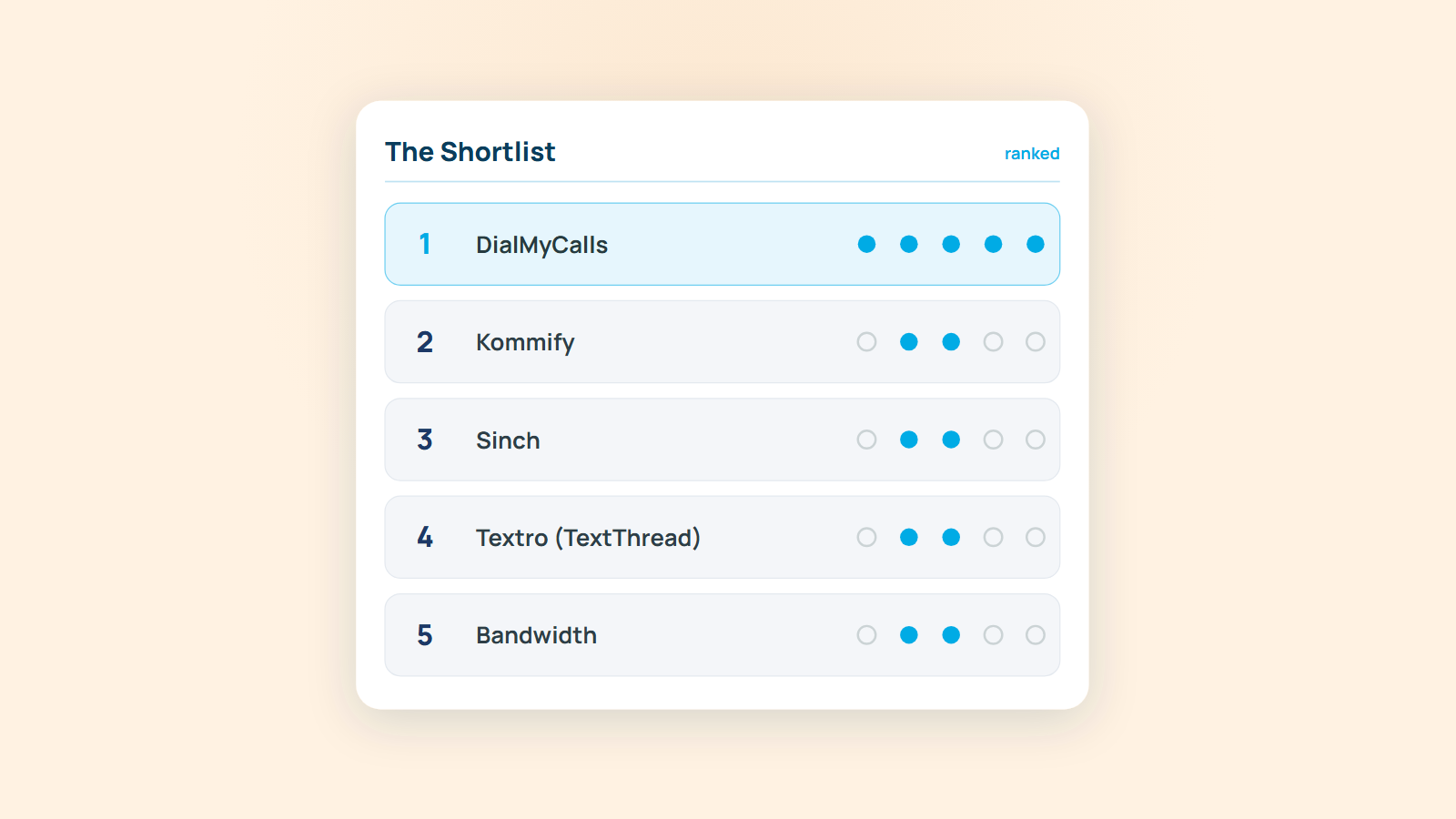
The platforms below are ranked by their audit trail depth, two-way messaging capability, CRM/SIS integration breadth, compliance enforcement, and pricing transparency. Each entry follows the same structure: an overview, key features, pricing, and honest pros and cons.
DialMyCalls: Best Overall for Property Management, Schools, Healthcare, and Emergency Alerts Requiring Multi-Channel Compliance-Ready Communication
DialMyCalls is a U.S.-based mass communication platform that delivers SMS text messaging, voice broadcasting, email notifications, and two-way texting from a single interface. It is built for operational, emergency, and transactional communication rather than marketing campaigns. Primary customers include property managers and HOAs, schools and school districts, businesses, churches and nonprofits, healthcare providers, manufacturing companies, transportation and logistics organizations, and government agencies.
Key features:
- Unified SMS, voice, and email communication with immutable audit trails logging timestamp (with timezone), sender identity, recipient ID, message content, delivery status, carrier response, and opt-in timestamp for every send.
- Two-way texting with recipient replies captured, timestamped, and logged in the same audit system as outbound messages, enabling appointment confirmations and customer responses.
- Integration with CRM, HR, and student information systems (SIS) for real-time contact sync, opt-in record updates, and automated workflows.
- DND list compliance allows transactional and emergency SMS to reach Do Not Disturb numbers 24/7 while blocking promotional SMS, with 10DLC messaging support for carrier registration and throttling detection.
Pricing: Pay-as-you-go from $0.01/SMS; monthly plans vary based on volume and features. No long-term contracts required.
Pros
- Multi-channel communication (SMS, voice, email) from one platform; immutable audit trails suitable for HIPAA, FERPA, and FINRA compliance; two-way texting with full reply logging; transparent pricing with no hidden fees; fast setup with no technical expertise required; suitable for emergency alerts and senior living management.
Cons
- CRM integrations are primarily API-based rather than pre-built native connectors for every system; advanced workflow automation requires configuration; international SMS rates vary by country and carrier; enterprise pricing may exceed $500-$3,000 monthly for high-volume users with compliance-grade audit retention.
Kommify: Best for E-Commerce and Retail Brands Needing CRM Sync and Customer Segmentation
Kommify is an e-commerce-focused SMS platform that integrates with Shopify, Razorpay, Meta Ads, and other retail systems to automate customer communication workflows. It is designed for marketing campaigns, abandoned cart recovery, and transactional notifications. The platform emphasizes segmentation, personalization, and automated workflows rather than deep audit trails or two-way conversation management.
Key features:
- Direct integrations with Shopify, Razorpay, Meta Ads, and other e-commerce platforms for real-time customer data sync and order status updates.
- Automated workflows for abandoned cart recovery, order confirmations, shipping notifications, and promotional campaigns.
- Customer segmentation based on purchase history, browsing behavior, and engagement metrics.
- Two-way SMS support for customer replies, though audit trail depth and compliance logging are less comprehensive than compliance-grade platforms.
Pricing: Pricing not publicly listed; contact sales for custom quotes based on message volume and integration requirements.
Pros
- Strong e-commerce integrations (Shopify, Razorpay, Meta Ads); automated workflows reduce manual outreach; customer segmentation and personalization features; suitable for marketing and transactional SMS; two-way messaging for customer service inquiries.
Cons
- Audit trail logging is less comprehensive than compliance-grade platforms; limited support for DND enforcement and carrier throttling detection; pricing transparency is low (no public tiers); not purpose-built for regulated industries (healthcare, finance, government); limited SIS or HR system integrations.
Sinch: Best for Global Enterprise Teams Requiring Carrier-Grade Infrastructure and Multi-Region Routing
Sinch is a global communications platform offering SMS, voice, video, and verification services through direct carrier connections. It is built for enterprise teams that need multi-region routing, 99%+ delivery SLAs, and carrier-grade infrastructure. Sinch serves international brands, telecommunications companies, and software platforms that embed communication features into their products.
Key features:
- 99%+ delivery SLA with global carrier network, auto-failover routing, and intelligent route optimization across 190+ countries.
- OTP delivery on priority routes averages sub-5 seconds; transactional SMS performance optimized for time-sensitive messages (banking, authentication, emergency alerts).
- Programmable APIs with webhook support for custom integrations, event-driven workflows, and real-time delivery status tracking.
- Compliance support for GDPR, HIPAA, and FINRA with audit trails, opt-in verification, and DND list management.
Pricing: Custom (contact sales); enterprise pricing based on message volume, geographic coverage, and route priority. Per-message costs typically range from $0.01 to $0.05 depending on volume and region.
Pros
- Global carrier-grade infrastructure with 99%+ uptime; multi-region routing with auto-failover; sub-5 second OTP delivery on priority routes; programmable APIs for custom integrations; compliance support for GDPR, HIPAA, and FINRA; suitable for high-volume international messaging.
Cons
- Pricing is not publicly listed (custom quotes only); setup and integration require technical expertise; primarily API-first (limited pre-built UI for non-technical users); enterprise-focused (not cost-effective for small teams or low-volume senders); audit trail depth varies by implementation (not guaranteed immutable logs out-of-the-box).
Textro (TextThread): Best for SMBs and Mid-Market Teams Needing Simple Two-Way Texting with Basic Compliance
Textro (also known as TextThread) is a lightweight SMS platform designed for small-to-midsize businesses that need simple two-way texting, team collaboration, and basic compliance features. It is built for customer service, appointment reminders, and internal team communication rather than large-scale broadcast messaging or deep regulatory compliance.
Key features:
- Lightweight inbox for managing recipient replies, team assignments, and conversation history.
- Two-way SMS with recipient replies captured, timestamped, and routable to specific team members or departments.
- Basic audit logging for sent and received messages, though immutable trails and cryptographic signing are not standard features.
- Team collaboration features including shared inboxes, assignment workflows, and internal notes.
Pricing: Pricing not publicly listed; contact sales for quotes based on user count and message volume.
Pros
- Simple interface with low learning curve; two-way SMS with team collaboration features; suitable for SMBs and customer service teams; basic audit logging for compliance; shared inbox reduces missed replies.
Cons
- Audit trail depth is less comprehensive than compliance-grade platforms (no immutable logs or cryptographic signing); limited CRM/SIS integrations (primarily API-based); DND enforcement and carrier throttling detection are not emphasized; pricing transparency is low (no public tiers); not purpose-built for regulated industries (healthcare, finance, government).
Bandwidth: Best for Developers Building Custom Communication Apps on Carrier-Grade APIs
Bandwidth is a programmable communications platform offering SMS, voice, and phone number APIs with direct carrier access. It is built for developers and engineering teams that need to embed SMS, voice, and verification features into their own applications. Bandwidth serves software platforms, SaaS companies, and enterprises building custom communication workflows rather than end-users seeking a ready-made SMS dashboard.
Key features:
- Programmable SMS APIs with direct carrier access, webhook support, and real-time delivery status tracking.
- Carrier-grade infrastructure with 99%+ uptime SLA, auto-failover routing, and intelligent rate-limit detection.
- Two-way SMS support with inbound message webhooks, enabling custom reply routing, conversation threading, and integration with third-party CRM or ticketing systems.
- Audit logging capabilities (timestamp, sender identity, recipient ID, delivery status, carrier response) accessible via API, though immutability and compliance packaging depend on implementation.
Pricing: Pay-per-message (volume-based); custom enterprise pricing for high-volume or compliance-grade deployments. Per-SMS costs typically range from $0.01 to $0.05 depending on volume, route priority, and geographic coverage.
Pros
- Programmable APIs with direct carrier access; 99%+ uptime SLA with auto-failover; two-way SMS with webhook-based reply routing; suitable for custom communication apps and SaaS platforms; transparent volume-based pricing for pay-per-message plans; developer-friendly documentation and support.
Cons
- Requires technical expertise to integrate and operate (no pre-built UI or dashboard for non-developers); audit trail immutability and compliance packaging depend on custom implementation; DND enforcement and carrier throttling must be built into application logic; not cost-effective or practical for non-technical teams; enterprise compliance features (immutable logs, regulatory reporting) require custom development.
AWS Pinpoint: Best for Engineering Teams Inside AWS Ecosystems Needing Scalable Transactional SMS
AWS Pinpoint is a multi-channel communication service (SMS, email, push notifications, voice) built into Amazon Web Services. It is designed for engineering teams that already operate inside AWS ecosystems and need to send transactional SMS, appointment reminders, OTP codes, and event-driven notifications at scale. Pinpoint integrates deeply with Lambda, EventBridge, S3, CloudWatch, and other AWS services.
Key features:
- Deep AWS integration with Lambda, EventBridge, S3, CloudWatch, and analytics pipelines, enabling event-driven SMS workflows triggered by application logic, database changes, or scheduled events.
- Transactional SMS optimized for OTP delivery, appointment confirmations, and time-sensitive notifications; OTP delivery on priority routes averages sub-5 seconds.
- Audit logging via CloudTrail and CloudWatch Logs, capturing timestamp, sender identity, recipient ID, delivery status, and carrier response; immutability depends on S3 bucket configuration and log retention policies.
- Multi-channel campaigns (SMS, email, push) with segmentation, A/B testing, and journey orchestration for customer engagement workflows.
Pricing: ~$0.00645/SMS; varies by region, message volume, and route priority. No base monthly fee; pay only for messages sent. Additional costs for email, push notifications, and analytics.
Pros
- Deep AWS integration for teams already on AWS; low per-message cost (~$0.00645/SMS); transactional SMS optimized for OTP and time-sensitive notifications; event-driven workflows via Lambda and EventBridge; audit logging via CloudTrail and CloudWatch; scalable for high-volume messaging.
Cons
- Requires AWS expertise to configure and operate (not suitable for non-technical teams); audit trail immutability depends on S3 bucket configuration (not guaranteed out-of-the-box); DND enforcement and carrier throttling must be built into application logic; limited pre-built CRM/SIS integrations (primarily API-based); compliance packaging (HIPAA BAA, FINRA audit reports) requires custom setup and AWS support engagement.
MessageBird: Best for International Teams Requiring Multi-Language, Multi-Channel Customer Engagement
MessageBird is an omnichannel communications platform offering SMS, WhatsApp, email, voice, and chat through a unified inbox and API. It is built for international teams that need multi-language support, multi-channel customer engagement, and compliance dashboards for GDPR and regional regulations. MessageBird serves e-commerce brands, customer support teams, and global enterprises that engage customers across multiple messaging channels.
Key features:
- Omnichannel inbox (SMS, WhatsApp, email, voice, chat) with unified conversation history, team collaboration, and multi-language support for international customer engagement.
- Two-way SMS and WhatsApp messaging with recipient replies captured, timestamped, and logged in the same audit system as outbound messages.
- Compliance dashboards for GDPR, opt-in verification, and DND list management; audit trails log timestamp, sender identity, recipient ID, message content, delivery status, and carrier response.
- Programmable APIs with webhook support for custom integrations, event-driven workflows, and CRM sync (Salesforce, HubSpot, Zendesk, Shopify).
Pricing: Custom (contact sales); enterprise pricing based on message volume, channel mix (SMS, WhatsApp, voice), and compliance requirements. Per-message costs typically range from $0.01 to $0.05 for SMS depending on volume and region.
Pros
- Omnichannel inbox (SMS, WhatsApp, email, voice) for unified customer engagement; multi-language support for international teams; compliance dashboards for GDPR and opt-in management; two-way messaging with reply logging; CRM integrations (Salesforce, HubSpot, Zendesk, Shopify); suitable for global customer support and e-commerce.
Cons
- Pricing is not publicly listed (custom quotes only); audit trail immutability depends on implementation (not guaranteed cryptographic signing out-of-the-box); primarily focused on customer engagement and marketing rather than regulatory compliance (HIPAA, FINRA); enterprise setup and integration require technical expertise; not optimized for emergency alerts or transactional SMS in regulated industries.
How to Choose the Right Two-Way SMS Platform for Your Organization
Procurement and operations teams should ask vendors the following questions before selecting an SMS platform. These questions distinguish compliance-ready, bidirectional SMS platforms from generic bulk texters.
What audit trail fields does your platform log for every outbound and inbound message? Compliance-grade SMS platforms must log timestamp (with timezone), sender identity, recipient ID, message content or hash, channel, delivery status, carrier response, and opt-in timestamp for every send. Ask whether logs are immutable, cryptographically signed, or stored in append-only databases to prevent tampering.
How does your platform handle recipient replies, and are replies logged in the same audit system as outbound messages? Two-way SMS requires recipient replies to be captured, timestamped, and logged alongside outbound messages in the same audit system. Ask how replies are routed to the correct team or workflow, and whether the platform unifies inbound and outbound message history for regulatory review.
Which CRM, SIS, and HR systems does your platform integrate with, and is the integration real-time or batch? CRM integration latency matters: real-time sync ensures contact data, appointment status, and opt-in records stay consistent between systems. Ask whether integrations are pre-built native connectors or API-based custom development, and how often data syncs occur.
How does your platform enforce Do Not Disturb (DND) lists, and can transactional or emergency SMS reach DND numbers? DND (Do Not Disturb) compliance varies by use case: transactional and emergency SMS may reach DND numbers 24/7, but promotional SMS cannot. Ask how the platform categorizes message types, whether DND enforcement is automatic, and how compliance is documented for audit purposes.
How does your platform detect and handle carrier throttling, and are retry attempts logged? Carrier throttling is a silent compliance risk: platforms must detect rate limits and log retry attempts so regulators can see full delivery efforts. Ask whether the platform automatically adapts to carrier-imposed rate limits, how retry attempts are logged, and whether throttling events are flagged for review.
What is your platform’s uptime SLA, and how is failover routing implemented? Platforms must guarantee 99%+ uptime with auto-failover routing for mission-critical communication. Ask about historical uptime performance, how failover routing works, and whether the platform supports multi-carrier routing for redundancy.
What are the per-message costs, and do they vary by route priority, volume, or geography? Per-message costs range from $0.01 to $0.05 depending on volume and route priority; enterprise compliance platforms cost $500 to $3,000+ monthly. Ask for a detailed pricing breakdown by message type (promotional, transactional, OTP), volume tier, and geographic coverage.
How long are audit trails retained, and can we export them for regulatory review? Opt-in proof requires platforms to retain consent records (date, method, source) for at least 3 years to defend against compliance audits. Ask about audit trail retention policies, export formats (CSV, JSON, API), and whether the platform supports regulator-ready reports.
Selection should weigh audit depth, integration breadth, and regulator-ready documentation over feature count. Teams consistently underestimate how often regulators request full delivery logs, opt-in proof, and retry history. Suppose your audit finds that a platform logs only sent messages but not recipient replies or retry attempts.
In that case, you cannot defend your compliance posture during a HIPAA, FINRA, or FERPA review, even if your team followed every opt-in and DND rule.
FAQs
What Makes Two-Way SMS Different from One-Way Bulk Texting for Compliance?
Two-way SMS captures, timestamps, and logs recipient replies in the same audit system as outbound messages, enabling regulatory reviewers to see the full conversation history, not just what you sent. One-way bulk texting treats inbound replies as optional or routes them to a separate system, leaving gaps in the audit trail.
Compliance-grade platforms unify inbound and outbound message logs so every send, delivery, and recipient response is traceable with timestamp, sender identity, recipient ID, message content, and opt-in status.
How Do I Audit SMS Opt-Ins for HIPAA or FINRA Compliance?
Opt-in proof requires platforms to retain consent records (date, method, source) for at least 3 years to defend against compliance audits. Export your platform’s opt-in logs and verify that each record includes the recipient’s phone number, consent timestamp, opt-in method (web form, keyword reply, verbal consent), source page or campaign, and IP address or device ID.
Missing or incomplete opt-in records cannot defend against HIPAA, FINRA, or FERPA enforcement actions, even if the recipient verbally agreed to receive messages.
Can Recipients Reply to Appointment Confirmation Texts?
Yes, if your platform supports two-way SMS and logs recipient replies with timestamp, sender identity, and message content. Appointment confirmation texts should include reply instructions (e.g., “Reply YES to confirm or NO to cancel”) and route replies to the correct team or workflow. Platforms that treat replies as afterthoughts or fail to log them create compliance gaps when regulators request full conversation histories.
What Does CRM Integration Mean for SMS Compliance?
CRM integration syncs contact data, opt-in status, appointment records, and message history between your SMS platform and systems like Salesforce, HubSpot, or property management software. Real-time sync ensures opt-in records stay consistent and up-to-date across platforms, preventing accidental messages to opted-out recipients. API-based integrations require custom development to maintain sync integrity, while pre-built native connectors reduce configuration errors and audit trail gaps.
How Do Platforms Enforce DND (Do Not Disturb) Lists?
Platforms enforce DND lists by blocking promotional SMS to Do Not Disturb numbers while allowing transactional and emergency SMS to reach DND numbers 24/7. DND compliance is automated: the platform checks each recipient against the DND registry before sending, logs the check result, and blocks or allows the message based on message type.
Audit trails must capture DND check status, message classification (promotional, transactional, emergency), and the reason for delivery or blocking to defend against regulatory review.
What is Carrier Throttling, and Why Does It Matter for Audits?
Carrier throttling is a silent compliance risk: platforms must detect rate limits imposed by mobile carriers and log retry attempts so regulators can see full delivery efforts. When carriers throttle message delivery to prevent spam, platforms must automatically adapt send rates, retry failed messages, and log every throttling event, retry count, and final delivery status.
Without throttling detection and retry logging, audit trails appear incomplete, making it impossible to prove you attempted full delivery.
How Long Must SMS Audit Trails Be Retained?
Opt-in proof and message delivery logs must be retained for at least 3 years to defend against HIPAA, FINRA, and FERPA compliance audits. Some industries (healthcare, finance) require longer retention periods (5 to 7 years). Ask your platform whether audit trails are retained automatically, whether storage is immutable (append-only), and how you can export logs for regulatory review or legal discovery.
What is the Difference Between Bulk SMS and Transactional SMS in Terms of Compliance?
Bulk SMS is promotional messaging (marketing campaigns, sales offers) that requires explicit opt-in consent and cannot reach Do Not Disturb numbers. Transactional SMS (appointment reminders, delivery notifications, OTP codes, emergency alerts) is operational communication that may reach DND numbers 24/7 and requires only prior business relationship or legitimate interest.
Compliance-grade platforms automatically classify message types, enforce opt-in and DND rules per category, and log classification decisions for audit purposes.