Ensure Critical SMS Alerts Reach Employees Who Ignore Email
TL;DR
- 61-76% of employees miss critical updates despite regular communication; email alone fails because frontline workers don’t check it during shifts.
- SMS alerts deliver 98% read rates within 3 minutes; two-way texting confirms receipt and action from maintenance technicians, dispatch drivers, and floor workers.
- Replace email-first workflows with SMS-primary channels for time-sensitive alerts; segment by role and shift so maintenance techs receive work orders via text, not email.
- Mandatory read receipts and action acknowledgements close the gap between delivery and comprehension that manager-relay systems leave open.
- Multi-channel routing (SMS + voice + email) ensures redundancy; dispatch drivers get route updates via SMS during shifts, then email confirmation for the record.
- Organizations using SMS-based alert systems report 34-40% faster response times and measurable reductions in missed critical notifications.
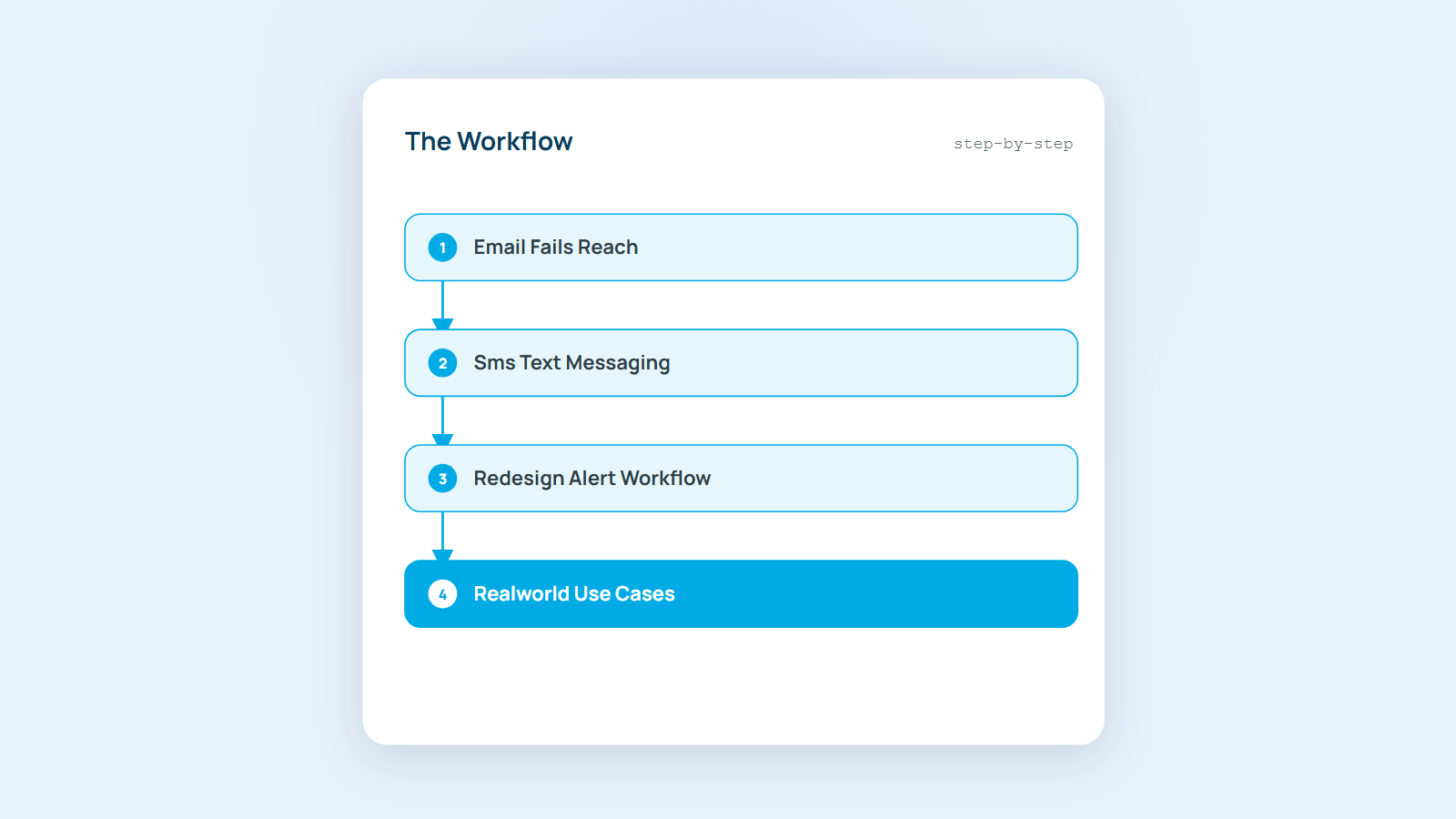
Critical alerts reach field workers via SMS instead of email because 61-76% of employees miss email-based announcements, especially shift workers and maintenance technicians who don’t check inboxes during operational hours. SMS delivers 98% read rates within 3 minutes and enables two-way acknowledgement, closing the gap between delivery and confirmation that email-only systems leave open.
Employee alert systems are notification workflows that replace email-first communication with SMS text messaging, voice broadcasting, and two-way texting to ensure field workers, maintenance technicians, and shift-based employees receive, acknowledge, and act on critical messages in real time. They solve the structural failure that email creates for frontline staff who don’t sit at desks or check computers during their shifts.
Why Email Fails to Reach Frontline Employees & Field Staff During Shifts
Email fails as a critical alert channel because 61-76% of employees miss updates despite regular communication, and the problem is structural rather than behavioral. Field workers, maintenance technicians, dispatch drivers, and floor staff do not check email during active work shifts because their roles require hands-on tasks, equipment operation, or time-sensitive movement across locations.
A work order sent via email to a maintenance technician who is fixing equipment on-site will not arrive until the technician returns to a desk or device, creating delays that compound into missed service windows and customer complaints.
The root cause runs deeper than device access. 70-77% of managers struggle to communicate effectively with frontline teams, and 62-65% bypass official channels entirely by using personal email or SMS because they know the formal system does not work. This creates a split between what organizations believe they communicated and what employees actually received.
When managers resort to personal texting or phone calls to relay critical messages, the organization loses documentation, compliance tracking, and any ability to measure delivery or response rates.
Information overload adds another layer. 44% of employees report feeling overwhelmed by communication volume and actively stop reading messages. When every announcement arrives via email with equal urgency, critical alerts blend into routine updates, and recipients develop message fatigue. A dispatch driver who receives 20 emails per shift cannot distinguish a route change that requires immediate action from a policy reminder or training announcement.
In our work with organizations managing distributed workforces, the first audit almost always reveals a reliance on manager relay as the unofficial escalation path. When an email alert does not reach its audience, a supervisor makes individual phone calls or texts to confirm receipt.
This workaround masks the system failure in aggregate metrics while creating unsustainable manual work for managers and unpredictable delivery times for employees.
How SMS Text Messaging Breaks Through Email Noise with High Delivery and Read Rates
SMS text messaging delivers 98% read rates within 3 minutes because it bypasses the inbox entirely and appears as a device-level notification that interrupts whatever the recipient is doing.
A maintenance technician who will not open email during a shift will see and read an SMS alert within seconds because the phone vibrates, the lock screen displays the message preview, and the red notification badge persists until the message is opened. This delivery mechanism makes SMS the default channel for time-sensitive alerts in industries where employees spend their day away from computers.
The effectiveness gap is measurable. Organizations using SMS-based alert systems report 34-40% faster response times compared to email-only workflows. A dispatch driver who receives a route update via SMS during a delivery run can acknowledge the change and adjust in real time, whereas the same message sent via email might not surface until the driver returns to the depot or checks a tablet between stops.
The response-time improvement translates directly into operational efficiency: fewer missed pickups, faster maintenance response, and reduced escalation calls from supervisors checking whether workers received critical instructions.
SMS also solves the segmentation problem that email creates. Email systems treat all messages as asynchronous communication, forcing senders to choose between overloading recipients with every update or risking that a critical alert gets buried in routine announcements. SMS allows organizations to reserve a distinct channel for urgent messages only.
When a maintenance technician knows that SMS means “act now” and email means “read when you can,” the recipient can prioritize without parsing subject lines or scanning message previews.
Two-way SMS closes the confirmation loop. A work order sent via SMS can require a reply or button press to acknowledge receipt, giving dispatchers and managers real-time visibility into who has seen the message and who needs follow-up. This replaces the manager-relay workaround with a structured feedback mechanism that scales across large teams.
Organizations using two-way SMS for manufacturing plant alerts report that floor workers who never check email during shifts now acknowledge safety alerts, equipment changes, and production schedule updates within minutes of broadcast.
Redesign Your Alert Workflow: Replace Email-First with SMS-Primary Channels for Critical Messages
Redesigning your alert workflow starts with identifying which messages require immediate action versus background awareness. Audit your last 90 days of email alerts and classify each by urgency, audience role, and whether the recipient was on-site or mobile when the message was sent.
Messages that require action within 2 hours, target field staff or shift workers, or involve safety, schedule changes, or operational disruptions should move to SMS. Messages that document decisions, provide reference material, or target desk-based employees can remain in email.
Map Message Types to Channels by Urgency and Recipient Role
Create a routing matrix that assigns each alert type to SMS, voice, email, or multi-channel delivery based on two dimensions: time sensitivity and recipient work environment. Emergency notifications, safety alerts, and immediate schedule changes go to SMS and voice broadcast for all staff, regardless of role. Work orders, maintenance requests, and dispatch updates go to SMS for field workers and email for office staff.
Policy updates, training reminders, and routine announcements stay in email for all roles.
Suppose your organization manages 40 maintenance technicians across 15 properties. Work orders currently arrive via email, and technicians check their inbox 3 to 5 times per day between service calls. Redesigning the workflow means routing work orders to SMS for technicians in the field and sending a parallel email for documentation and attachment storage.
The technician receives the alert instantly via SMS, acknowledges receipt with a reply or button press, and opens the email later to access floor plans, equipment manuals, or resident contact details.
Segment Your Audience by Shift, Location, and Device Access
Build contact segments that reflect how employees actually work, not how the org chart is drawn. Maintenance staff, dispatch drivers, and floor workers form one segment that receives time-sensitive alerts via SMS. Office staff, managers with desk access, and administrative teams form another segment that can rely on email for most communication.
Hybrid roles, such as shift supervisors who split time between the floor and an office, receive critical alerts via both SMS and email to ensure coverage regardless of where they are when the message arrives.
Teams consistently underestimate how fragmented device access becomes across shift-based workforces. A second-shift manufacturing worker may not have a company email address or check it more than once per week, but carries a personal phone at all times. SMS reaches this worker immediately; email does not.
The segmentation step forces organizations to map communication channels to actual device ownership and usage patterns rather than assuming universal email access.
Implement Mandatory Acknowledgement and Escalation Rules
Configure your SMS alert system to require acknowledgement for critical messages and trigger escalation when a recipient does not respond within a defined window. A maintenance technician who receives a work order via SMS has 15 minutes to acknowledge receipt by replying or pressing a button.
If no acknowledgement arrives, the system escalates the alert to the technician’s supervisor via SMS and voice call, then sends a second SMS to the technician with an urgent flag. This creates accountability without manual follow-up and surfaces non-response patterns that indicate training gaps or staffing shortages.
Escalation rules also prevent single points of failure. If a dispatch driver does not acknowledge a route change within 10 minutes, the system alerts the dispatcher and sends a voice broadcast to the driver’s phone. The dispatcher can then decide whether to reassign the route, make a direct call, or wait for the driver to check in at the next scheduled stop.
The escalation workflow documents every step for compliance and post-incident review.
Preserve Email for Documentation and Non-Urgent Communication
Do not eliminate email entirely. SMS and voice handle time-sensitive alerts, but email remains the system of record for attachments, detailed instructions, policy documents, and messages that require no immediate action. Send the work order alert via SMS, then follow with an email that includes the service ticket, resident contact information, and equipment warranty details.
The technician acts on the SMS and references the email when needed, rather than waiting to check email before starting work.
This dual-channel approach also satisfies compliance and audit requirements. Regulatory frameworks in healthcare, transportation, and property management often require written documentation of work orders, schedule changes, and safety communications. SMS provides the immediate alert and acknowledgement; email provides the auditable record with timestamps, attachments, and full message history.
Real-World Use Cases: How Property Management, Schools, and Logistics Apply SMS Alerts
Property management companies use SMS alerts to coordinate maintenance response across multiple buildings and ensure technicians receive work orders during active shifts. A property manager overseeing 10 apartment complexes sends maintenance requests via SMS to the on-duty technician’s mobile phone. The technician acknowledges receipt, completes the repair, and replies with a status update, all without returning to the office or checking email.
Urgent issues such as water leaks, heating failures, or security concerns trigger multi-channel alerts that combine SMS with voice calls to ensure the technician responds within 30 minutes. Employee alert systems designed for property management also route tenant notifications and emergency announcements via SMS to ensure residents receive critical updates regardless of whether they check email.
When a water main break requires shutting off service to an entire building, the property manager broadcasts an SMS alert to all affected units, sends a follow-up email with detailed instructions and estimated restoration times, and posts a voice message to the building’s main phone line.
This multi-channel approach reaches tenants who rely solely on text messaging as well as those who prefer email or voice.
School districts apply SMS alerts to notify parents, staff, and bus drivers about closures, delays, and safety incidents. A school superintendent closes campuses due to severe weather and sends an SMS alert to 8,000 parent contacts and 400 staff members at 5:30 AM, 90 minutes before the first bell. Parents receive the message before leaving home, reducing unnecessary trips and call volume to school offices.
Bus drivers receive route cancellations via SMS and acknowledge receipt, giving transportation coordinators real-time confirmation that every driver has been notified and no buses will run.
Two-way SMS also supports attendance and check-in workflows for schools. A parent who receives an absence alert via SMS can reply directly to confirm that the absence is excused, eliminating the need for phone calls or signed notes. The SMS system logs the reply and updates the student’s attendance record automatically, reducing administrative workload and improving accuracy.
Logistics and transportation companies use SMS alerts to update dispatch drivers about route changes, pickup additions, and delivery delays while drivers are on the road. A dispatch coordinator managing 25 delivery drivers sends route updates via SMS when a customer requests an expedited pickup.
The driver receives the alert immediately, acknowledges the new stop, and adjusts the route without returning to the depot or calling the dispatcher. The SMS system tracks acknowledgement status in real time, giving the coordinator visibility into which drivers have received and confirmed the update.
Emergency alerts for transportation and logistics also rely on SMS to communicate vehicle breakdowns, traffic disruptions, and safety incidents. When a delivery truck breaks down on a highway, the driver sends an SMS alert to dispatch, triggering an automatic escalation to the operations manager and roadside assistance.
The system logs the incident, tracks response times, and sends follow-up alerts to customers affected by the delay, all without requiring manual coordination or phone calls.
Manufacturing plants apply SMS alerts to reach floor workers who do not have company email addresses or desk access. A production supervisor broadcasts a shift change via SMS to 120 floor workers 2 hours before the change takes effect. Workers acknowledge receipt by replying to the SMS, and the system generates a confirmation report showing which employees have been notified and which require follow-up.
This replaces the previous process of posting paper notices on bulletin boards and relying on shift leads to verbally inform workers, both of which created gaps in communication and documentation.
| Industry | Alert Type | Primary Channel | Acknowledgement Requirement | Typical Response Time |
|---|---|---|---|---|
| Property Management | Maintenance Work Orders | SMS to Technicians | Required within 15 minutes | Under 30 minutes |
| Schools | Closure & Delay Notifications | SMS to Parents & Staff | Optional (delivery confirmation tracked) | Within 5 minutes |
| Logistics | Route Updates | SMS to Drivers | Required within 10 minutes | Under 10 minutes |
| Manufacturing | Shift Changes & Safety Alerts | SMS to Floor Workers | Required within 20 minutes | Under 15 minutes |
| Healthcare | Appointment Reminders | SMS to Patients | Optional (reply to confirm) | Within 3 minutes |
Measurement and Governance: Track Delivery, Read Rates, and Action Confirmation
Measuring alert effectiveness requires tracking three layers: delivery confirmation, read receipts, and action acknowledgement. Delivery confirmation verifies that the SMS reached the recipient’s device and was not blocked by carrier filters or incorrect phone numbers. Read receipts, when supported by the recipient’s device and carrier, show that the message was opened.
Action acknowledgement, triggered by a reply or button press, confirms that the recipient understood the message and intends to act.
Organizations should track delivery rates above 95%, read rates above 90%, and acknowledgement rates above 85% for critical alerts. Delivery rates below 95% indicate phone number hygiene problems, carrier filtering, or opt-out issues that require immediate cleanup. Read rates below 90% suggest message fatigue, poor timing, or unclear subject lines.
Acknowledgement rates below 85% point to workflow gaps, insufficient training, or workers who do not understand the acknowledgement requirement.
Response time is the operational metric that matters most. Measure the elapsed time between when the alert is sent and when the recipient acknowledges receipt or completes the requested action. A maintenance technician who acknowledges a work order within 5 minutes but does not arrive on-site for 90 minutes reveals a different problem than one who does not acknowledge for 45 minutes.
Break response time into acknowledgement lag (time to reply) and completion lag (time to finish the task) to identify whether delays stem from notification failures or capacity constraints.
Compare SMS-based alerts to the email-only baseline you measured before redesigning the workflow. Suppose your audit found that email-based work orders had a median response time of 120 minutes and a 40% non-response rate within the first 2 hours. After switching to SMS, the median response time drops to 25 minutes and the non-response rate falls to 8%.
This 34-40% improvement in response time matches the range organizations report when moving from email to SMS for field-worker communication, and the reduced non-response rate eliminates most manager-relay escalations.
Track escalation frequency as a secondary metric. Count how often an alert triggers the escalation workflow because the primary recipient did not acknowledge within the defined window. High escalation rates indicate that acknowledgement windows are too short, workers are overwhelmed, or the wrong people are receiving the alerts.
Low escalation rates confirm that the workflow is functioning as designed and that most recipients respond before supervisor intervention is required.
Governance requires regular review of opt-out rates, complaint trends, and feedback from recipients. Monitor how many employees opt out of SMS alerts each month and survey those who do to understand whether the issue is message frequency, relevance, or personal preference.
A sudden spike in opt-outs after introducing SMS alerts suggests that the message volume is too high or that non-urgent messages are being sent via SMS when they belong in email. Adjust the routing matrix and escalation rules based on this feedback to maintain high engagement without overwhelming recipients.
How to Choose the Right Employee Alert System for Your Team
Choosing an employee alert system starts with defining your primary use case and the communication gaps you need to close.
Organizations that manage field workers, maintenance technicians, or shift-based employees require SMS-first platforms with two-way messaging, acknowledgement tracking, and multi-channel routing. DialMyCalls delivers mass text messaging, voice broadcasting, and two-way texting from a single platform, designed specifically for operational and emergency communication rather than marketing campaigns.
It supports property managers coordinating maintenance across multiple buildings, school districts notifying parents and staff about closures, and logistics companies updating dispatch drivers during active routes.
Evaluate platforms based on delivery infrastructure, not feature lists. SMS delivery rates, carrier relationships, and redundancy across multiple SMS gateways determine whether your alerts actually reach recipients during high-volume events or network congestion. Platforms that rely on a single carrier or gateway will fail during emergencies when network capacity is constrained.
Ask vendors for delivery-rate data during peak usage, average time to delivery, and how they handle carrier filtering and phone number validation.
Two-way SMS and acknowledgement tracking are non-negotiable for critical alerts. The platform must support reply-based acknowledgement, button-press confirmation, or both, and provide real-time dashboards showing which recipients have acknowledged and which require follow-up. This visibility replaces manual tracking and enables supervisors to escalate only to the employees who have not responded, rather than calling every worker to confirm receipt.
Multi-channel routing ensures redundancy for the most critical messages. The platform should allow you to send an SMS alert first, follow with a voice broadcast if no acknowledgement arrives within a defined window, and send an email for documentation. This layered approach reaches recipients regardless of device availability and creates an auditable trail for compliance and post-incident review.
Integration with existing systems reduces manual data entry and keeps contact lists accurate.
Platforms that integrate with HR systems, property management software, or dispatch platforms can automatically sync employee phone numbers, shift schedules, and role assignments, ensuring that alerts reach the right people without requiring admins to maintain duplicate contact lists. Workplace emergency procedures benefit from this automation because accurate contact data is the foundation of effective alert delivery during incidents.
Cost should reflect usage patterns, not arbitrary seat counts. Platforms that charge per user penalize organizations with large part-time or seasonal workforces. Look for pricing based on message volume or contact count, with clear overage policies and no hidden fees for delivery confirmations or acknowledgement tracking. Organizations managing 500 to 5,000 contacts typically find that per-message pricing offers better value and flexibility than per-seat models.
Pilot the platform with a small, high-stakes use case before rolling it out organization-wide. Select a group of maintenance technicians, dispatch drivers, or floor workers who currently experience the highest rate of missed email alerts, and run SMS-based alerts in parallel with your existing email workflow for 30 days.
Measure delivery rates, acknowledgement rates, and response times for both channels, and survey recipients about clarity, timing, and ease of use. Use the pilot data to refine your routing matrix and escalation rules before expanding to the full organization.
FAQs
What Percentage of Employees Miss Critical Email Announcements?
61-76% of employees miss critical updates despite regular communication, according to a 2023 survey of 6,200 employees. Email-first workflows fail because frontline workers don’t check inboxes during shifts, and information overload causes recipients to stop reading non-urgent messages.
Why is SMS More Effective Than Email for Reaching Field Workers?
SMS delivers 98% read rates within 3 minutes because it appears as a device-level notification that interrupts the recipient, bypassing the inbox entirely. Field workers who ignore email during active shifts will see and read an SMS alert immediately, making it the default channel for time-sensitive operational communication.
How Does Two-Way SMS Improve Alert Effectiveness?
Two-way SMS requires recipients to acknowledge receipt by replying or pressing a button, giving managers real-time visibility into who has seen the message and who needs follow-up. This replaces manual confirmation calls and creates an auditable record of delivery, read status, and action acknowledgement for compliance and incident review.
What Types of Alerts Should Use SMS Versus Email?
SMS should handle time-sensitive alerts that require action within 2 hours, including work orders, schedule changes, safety incidents, and dispatch updates for field staff. Email remains appropriate for documentation, policy updates, reference material, and messages targeting desk-based employees who check inboxes regularly.
How Much Faster Do Field Workers Respond to SMS Alerts Versus Email?
Organizations using SMS-based alert systems report 34-40% faster response times compared to email-only workflows. A dispatch driver who acknowledges a route update via SMS can act within minutes, whereas the same message sent via email may not surface until the driver checks a device at the depot or between stops.
Should Organizations Abandon Email Entirely in Favor of SMS?
No. SMS handles time-sensitive alerts and immediate action requests, but email remains the system of record for attachments, detailed instructions, and audit trails. The optimal workflow sends critical alerts via SMS for immediate visibility and follows with email for documentation, compliance, and reference material that does not require instant action.
What Metrics Should I Track to Measure Alert Effectiveness?
Track delivery rates above 95%, read rates above 90%, acknowledgement rates above 85%, and median response time from alert to action. Compare these metrics to your email-only baseline to quantify improvement, and monitor escalation frequency to identify workflow gaps or acknowledgement windows that are too short.
How Do I Avoid Alert Fatigue When Implementing SMS Notifications?
Reserve SMS for critical, time-sensitive messages only, and keep routine updates in email. Build a routing matrix that assigns each alert type to the appropriate channel based on urgency and recipient role, and survey employees regularly to ensure message volume and relevance remain appropriate for the SMS channel.